Retisser la frontière
Collage cartographique d’une infime partie de la frontière du Meghalaya (Inde) et du Sylhet (Bangladesh)
Keywords:
India-Bangladesh border, Cartographic collage, Border fence, Transboundary circulation and exchanges, Ethnographic methodologyAbstract
This article proposes a subjective cartographic collage as a tool for analyzing and conveying the lived experience of the India-Bangladesh border, based on fieldwork conducted in the state of Meghalaya between 2017 and 2022. Far from being a simple line, the border appears as a shifting space shaped by the legacy of Partition, military presence, an unfinished fence, and formal and informal economic flows. The map illustrates the daily dynamics of residents, who navigate around or adapt to the constraints imposed by surveillance and the fence. It makes cross-border interactions visible, notably through the “Border Hat” markets as well as cattle trafficking. The collage combines observations, photographs, interviews, and residents’ mental maps to offer a holistic reading of a fragmented border. The accompanying text explains the methodological choices and field experiences, allowing an understanding of how the fence generates social, economic, and political issues. The map thus becomes a reflexive and analytical tool, documenting the rapid transformations of this space and the stakes it entails both for the border population and the researcher .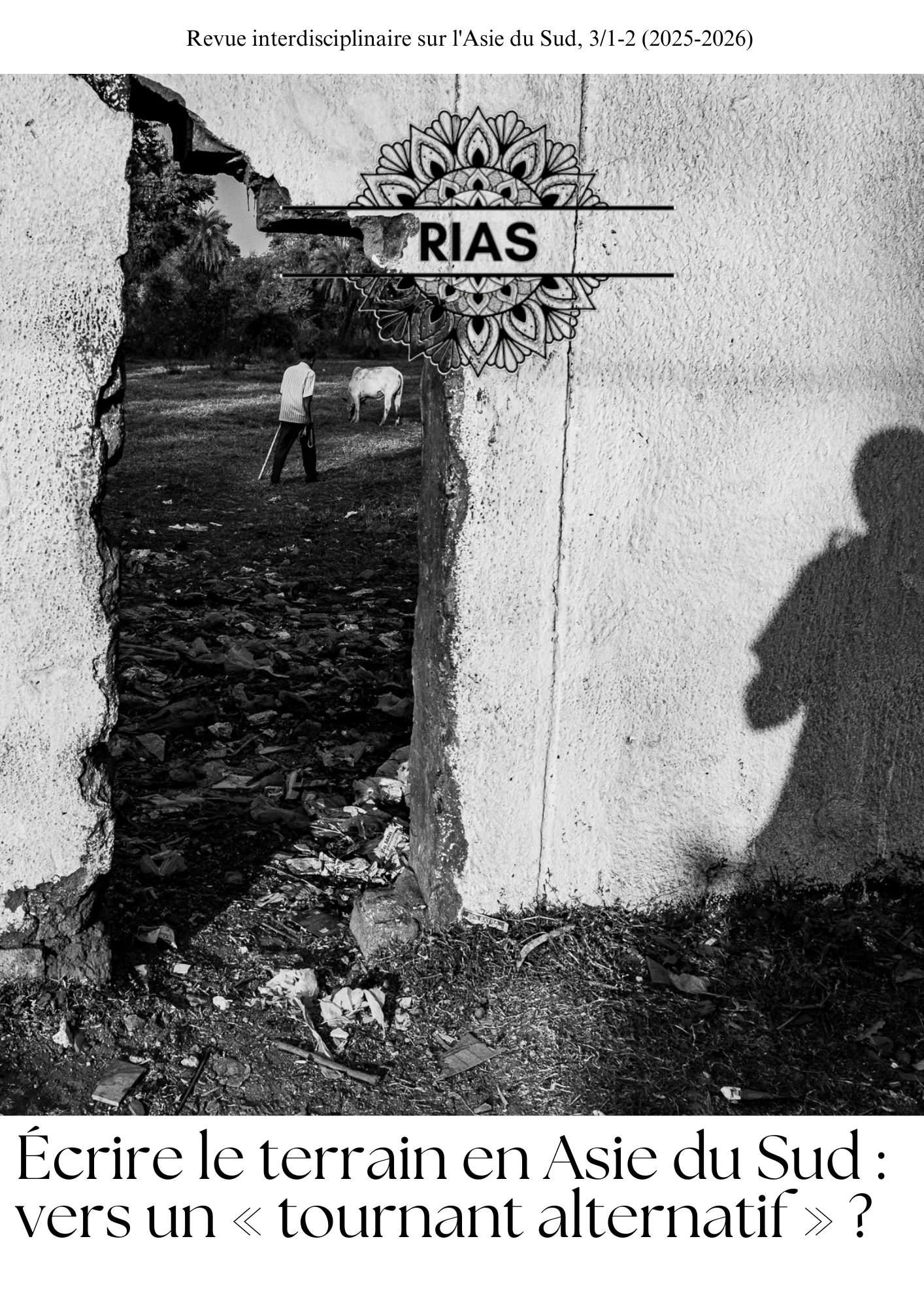
Published
How to Cite
Issue
Section
License
Copyright (c) 2026 Interdisciplinary Journal on South Asia

This work is licensed under a Creative Commons Attribution-NonCommercial-NoDerivatives 4.0 International License.
https://creativecommons.org/licenses/by-nc-nd/4.0/deed.fr
Licence publique Creative Commons Attribution - Utilisation non commerciale - Pas d’Œuvre dérivée 4.0 International
Lorsque Vous exercez les Droits accordés par la licence (définis ci-dessous), Vous acceptez d'être lié par les termes et conditions de la présente Licence publique Creative Commons Attribution - Utilisation non commerciale - Pas d’Œuvre dérivée 4.0 International (la « Licence publique »). Dans la mesure où la présente Licence publique peut être interprétée comme un contrat, Vous bénéficiez des Droits accordés par la licence en contrepartie de Votre acceptation des présents termes et conditions, et le Donneur de licence Vous accorde ces droits en contrepartie des avantages que lui procure le fait de mettre à disposition l’Œuvre sous licence en vertu des présents termes et conditions.
Article 1 - Définitions.
- Œuvre dérivée signifie œuvre protégée par les Droit d’auteur et droits connexes, dérivée ou adaptée de l’Œuvre sous licence et dans laquelle l’Œuvre sous licence est traduite, retouchée, arrangée, transformée, ou modifiée de telle façon que l’autorisation du Donneur de licence est nécessaire, conformément aux dispositions des Droit d’auteur et droits connexes. Dans le cas de la présente Licence publique, lorsque l’Œuvre sous licence est une œuvre musicale, une représentation publique ou un enregistrement sonore, la synchronisation de l'Œuvre sous licence avec une image animée sera considérée comme une Œuvre dérivée aux fins de la présente Licence publique.
- Droit d’auteur et droits connexes signifie droit d’auteur et/ou droits connexes incluant, notamment, la représentation, la radio et télédiffusion, l’enregistrement sonore et le Droit sui generis des producteurs de bases de données, quelle que soit la classification ou qualification juridique de ces droits. Dans le cadre de la présente Licence publique, les droits visés à l’Article 2(b)(1)-(2) ne relèvent ni du Droit d’auteur ni de droits connexes.
- Mesures techniques efficaces signifie mesures techniques qui, en l’absence d’autorisation expresse, ne peuvent être contournées dans le cadre de lois conformes aux dispositions de l’Article 11 du Traité de l’OMPI sur le droit d’auteur adopté le 20 Décembre 1996 et/ou d’accords internationaux de même objet.
- Exceptions et limitations signifie utilisation loyale et équitable (fair use et fair dealing) et/ou toute autre exception ou limitation applicable à Votre utilisation de l’Œuvre sous licence.
- Œuvre sous licence signifie œuvre littéraire ou artistique, base de données ou toute autre œuvre pour laquelle le Donneur de licence a recours à la présente Licence publique.
- Droits accordés par la licence signifie droits qui Vous sont accordés selon les termes et conditions d’utilisation définis par la présente Licence publique, limités aux Droit d’auteur et droits connexes applicables à Votre utilisation de l’Œuvre sous licence et que le Donneur de licence a le droit d’accorder.
- Donneur de licence signifie un individu ou une entité octroyant la présente Licence publique et les droits accordés par elle.
- Utilisation non commerciale signifie que l’utilisation n’a pas principalement pour but ou pour objectif d'obtenir un avantage commercial ou une compensation financière. L’échange de l’Œuvre sous licence avec d’autres œuvres soumises aux Droit d’auteur et droits connexes par voie de partage de fichiers numériques ou autres moyens analogues constitue une Utilisation non commerciale à condition qu’il n’y ait aucun avantage commercial ni aucune compensation financière en relation avec la transaction.
- Partager signifie mettre une œuvre à la disposition du public par tout moyen ou procédé qui requiert l’autorisation découlant des Droits accordés par la licence, tels que les droits de reproduction, de représentation au public, de distribution, de diffusion, de communication ou d’importation, y compris de manière à ce que chacun puisse y avoir accès de l’endroit et au moment qu’il choisit individuellement.
- Droit sui generis des producteurs de bases de données signifie droits distincts du droit d'auteur résultant de la Directive 96/9/CE du Parlement européen et du Conseil du 11 mars 1996 sur la protection juridique des bases de données, ainsi que tout autre droit de nature équivalente dans le monde.
- Vous (preneur de licence) se rapporte à tout individu ou entité exerçant les Droits accordés par la licence. Votre et Vos renvoient également au preneur de licence.
Article 2 - Champ d’application de la présente Licence publique.
- Octroi de la licence.
- Sous réserve du respect des termes et conditions d'utilisation de la présente Licence publique, le Donneur de licence Vous autorise à exercer pour le monde entier, à titre gratuit, non sous-licenciable, non exclusif, irrévocable, les Droits accordés par la licence afin de :
- reproduire et Partager l’Œuvre sous licence, en tout ou partie, seulement pour une Utilisation non commerciale ; et
- produire et reproduire, mais pas de Partager, l’Œuvre dérivée seulement pour une Utilisation non commerciale.
- Exceptions et limitations. Afin de lever toute ambiguïté, lorsque les Exceptions et limitations s’appliquent à Votre utilisation, la présente Licence publique ne s’applique pas et Vous n’avez pas à Vous conformer à ses termes et conditions.
- Durée. La durée de la présente Licence publique est définie à l’Article 6(a).
- Supports et formats : modifications techniques autorisées. Le Donneur de licence Vous autorise à exercer les Droits accordés par la licence sur tous les supports et formats connus ou encore inconnus à ce jour, et à apporter toutes les modifications techniques que ceux-ci requièrent. Le Donneur de licence renonce et/ou accepte de ne pas exercer ses droits qui pourraient être susceptibles de Vous empêcher d’apporter les modifications techniques nécessaires pour exercer les Droits accordés par la licence, y compris celles nécessaires au contournement des Mesures techniques efficaces. Dans le cadre de la présente Licence publique, le fait de ne procéder qu’à de simples modifications techniques autorisées selon les termes du présent Article 2(a)(4) n’est jamais de nature à créer une Œuvre dérivée.
- Utilisateurs en aval.
- Offre du Donneur de licence – Œuvre sous licence. Chaque utilisateur de l’Œuvre sous licence reçoit automatiquement une offre de la part du Donneur de licence lui permettant d’exercer les Droits accordés par la licence selon les termes et conditions de la présente Licence publique.
- Pas de restrictions en aval pour les utilisateurs suivants. Vous ne pouvez proposer ou imposer des termes et conditions supplémentaires ou différents, ou appliquer quelque Mesure technique efficace que ce soit à l’Œuvre sous licence si ceux(celles)-ci sont de nature à restreindre l’exercice des Droits accordés par la licence aux utilisateurs de l’Œuvre sous licence.
- Non approbation. Aucun élément de la présente Licence publique ne peut être interprété comme laissant supposer que le preneur de licence ou que l’utilisation qu’il fait de l’Œuvre sous licence est lié à, parrainé, approuvé, ou doté d'un statut officiel par le Donneur de licence ou par toute autre personne à qui revient l’attribution de l’Œuvre sous licence, comme indiqué à l’Article 3(a)(1)(A)(i).
- Sous réserve du respect des termes et conditions d'utilisation de la présente Licence publique, le Donneur de licence Vous autorise à exercer pour le monde entier, à titre gratuit, non sous-licenciable, non exclusif, irrévocable, les Droits accordés par la licence afin de :
-
Autres droits.
- Les droits moraux, tel que le droit à l’intégrité de l’œuvre, ne sont pas accordés par la présente Licence publique, ni le droit à l’image, ni le droit au respect de la vie privée, ni aucun autre droit de la personnalité ou apparenté ; cependant, dans la mesure du possible, le Donneur de licence renonce et/ou accepte de ne pas faire valoir les droits qu’il détient de manière à Vous permettre d’exercer les Droits accordés par la licence.
- Le droit des brevets et le droit des marques ne sont pas concernés par la présente Licence publique.
- Dans la mesure du possible, le Donneur de licence renonce au droit de collecter des redevances auprès de Vous pour l’exercice des Droits accordés par la licence, directement ou indirectement dans le cadre d’un régime de gestion collective facultative ou obligatoire assorti de possibilités de renonciation quel que soit le type d’accord ou de licence. Dans tous les autres cas, le Donneur de licence se réserve expressément le droit de collecter de telles redevances, y compris en dehors des cas d'Utilisation non commerciale de l’Œuvre sous licence.
Article 3 – Conditions d'utilisation de la présente Licence publique.
L’exercice des Droits accordés par la licence est expressément soumis aux conditions suivantes.
-
Attribution.
-
Si Vous partagez l’Œuvre sous licence, Vous devez :
- conserver les informations suivantes lorsqu’elles sont fournies par le Donneur de licence avec l’Œuvre sous licence :
- identification du(des) auteur(s) de l’Œuvre sous licence et de toute personne à qui revient l’attribution de l’Œuvre sous licence, dans la mesure du possible, conformément à la demande du Donneur de licence (y compris sous la forme d’un pseudonyme s’il est indiqué) ;
- l’indication de l’existence d’un droit d’auteur ;
- une notice faisant référence à la présente Licence publique ;
- une notice faisant référence aux limitations de garantie et exclusions de responsabilité ;
- un URI ou un hyperlien vers l’Œuvre sous licence dans la mesure du possible ;
- Indiquer si Vous avez modifié l’Œuvre sous licence et conserver un suivi des modifications précédentes ; et
- Indiquer si l’Œuvre sous licence est mise à disposition en vertu de la présente Licence publique en incluant le texte, l’URI ou l’hyperlien correspondant à la présente Licence publique.
- conserver les informations suivantes lorsqu’elles sont fournies par le Donneur de licence avec l’Œuvre sous licence :
- Vous pouvez satisfaire aux conditions de l’Article 3(a)(1) dans toute la mesure du possible, en fonction des supports, moyens et contextes dans lesquels Vous Partagez l’Œuvre sous licence. Par exemple, Vous pouvez satisfaire aux conditions susmentionnées en fournissant l’URI ou l’hyperlien vers la ressource incluant les informations requises.
- Bien que requises aux termes de l’Article 3(a)(1)(A), certaines informations devront être retirées, dans la mesure du possible, si le Donneur de licence en fait la demande.
-
Article 4 – Le Droit sui generis des producteurs de bases de données.
Lorsque les Droits accordés par la licence incluent le Droit sui generis des producteurs de bases de données applicable à Votre utilisation de l’Œuvre sous licence :
- afin de lever toute ambiguïté, l’Article 2(a)(1) Vous accorde le droit d’extraire, réutiliser, reproduire et Partager la totalité ou une partie substantielle du contenu de la base de données uniquement pour une Utilisation non commerciale et à condition que Vous ne partagiez pas d’Œuvre dérivée ;
- si Vous incluez la totalité ou une partie substantielle du contenu de la base de données dans une base de données pour laquelle Vous détenez un Droit sui generis de producteur de bases de données, la base de données sur laquelle Vous détenez un tel droit (mais pas ses contenus individuels) sera alors considérée comme une Œuvre dérivée ; et
- Vous devez respecter les conditions de l’Article 3(a) si Vous Partagez la totalité ou une partie substantielle du contenu des bases de données.
Afin de lever toute ambiguïté, le présent Article 4 complète mais ne remplace pas Vos obligations découlant des termes de la présente Licence publique lorsque les Droits accordés par la licence incluent d’autres Droit d’auteur et droits connexes.
Article 5 – Limitations de garantie et exclusions de responsabilité.
- Sauf indication contraire et dans la mesure du possible, le Donneur de licence met à disposition l’Œuvre sous licence telle quelle, et n’offre aucune garantie de quelque sorte que ce soit, notamment expresse, implicite, statutaire ou autre la concernant. Cela inclut, notamment, les garanties liées au titre, à la valeur marchande, à la compatibilité de certaines utilisations particulières, à l’absence de violation, à l’absence de vices cachés ou autres défauts, à l’exactitude, à la présence ou à l’absence d’erreurs connues ou non ou susceptibles d’être découvertes dans l’Œuvre sous licence. Lorsqu’une limitation de garantie n’est pas autorisée en tout ou partie, cette clause peut ne pas Vous être applicable.
- Dans la mesure du possible, le Donneur de licence ne saurait voir sa responsabilité engagée vis-à-vis de Vous, quel qu’en soit le fondement juridique (y compris, notamment, la négligence), pour tout préjudice direct, spécial, indirect, incident, conséquentiel, punitif, exemplaire, ou pour toutes pertes, coûts, dépenses ou tout dommage découlant de l’utilisation de la présente Licence publique ou de l’utilisation de l’Œuvre sous licence, même si le Donneur de licence avait connaissance de l’éventualité de telles pertes, coûts, dépenses ou dommages. Lorsqu’une exclusion de responsabilité n’est pas autorisée en tout ou partie, cette clause peut ne pas Vous être applicable.
- Les limitations de garantie et exclusions de responsabilité ci-dessus doivent être interprétées, dans la mesure du possible, comme des limitations et renonciations totales de toute responsabilité.
Article 6 – Durée et fin.
- La présente Licence publique s’applique pendant toute la durée de validité des Droits accordés par la licence. Cependant, si Vous manquez à Vos obligations prévues par la présente Licence publique, Vos droits accordés par la présente Licence publique seront automatiquement révoqués.
-
Lorsque les Droits accordés par la licence ont été révoqués selon les termes de l’Article 6(a), ils seront rétablis :
- automatiquement, à compter du jour où la violation aura cessé, à condition que Vous y remédiiez dans les 30 jours suivant la date à laquelle Vous aurez eu connaissance de la violation ; ou
- à condition que le Donneur de licence l’autorise expressément.
- Afin de lever toute ambiguïté, le Donneur de licence peut également proposer l’Œuvre sous licence selon d’autres termes et conditions et peut cesser la mise à disposition de l’Œuvre sous licence à tout moment ; une telle cessation n’entraîne pas la fin de la présente Licence publique.
- Les Articles 1, 5, 6, 7, et 8 continueront à s’appliquer même après la résiliation de la présente Licence publique.
Article 7 – Autres termes et conditions.
- Sauf accord exprès, le Donneur de licence n’est lié par aucune modification des termes de Votre part.
- Tous arrangements, ententes ou accords relatifs à l’Œuvre sous licence non mentionnés dans la présente Licence publique sont séparés et indépendants des termes et conditions de la présente Licence publique.
Article 8 – Interprétation.
- Afin de lever toute ambiguïté, la présente Licence publique ne doit en aucun cas être interprétée comme ayant pour effet de réduire, limiter, restreindre ou imposer des conditions plus contraignantes que celles qui sont prévues par les dispositions légales applicables.
- Dans la mesure du possible, si une clause de la présente Licence publique est déclarée inapplicable, elle sera automatiquement modifiée a minima afin de la rendre applicable. Dans le cas où la clause ne peut être modifiée, elle sera écartée de la présente Licence publique sans préjudice de l’applicabilité des termes et conditions restants.
- Aucun terme ni aucune condition de la présente Licence publique ne sera écarté(e) et aucune violation ne sera admise sans l’accord exprès du Donneur de licence.
- Aucun terme ni aucune condition de la présente Licence publique ne constitue ou ne peut être interprété(e) comme une limitation ou une renonciation à un quelconque privilège ou à une immunité s’appliquant au Donneur de licence ou à Vous, y compris lorsque celles-ci émanent d’une procédure légale, quel(le) qu’en soit le système juridique concerné ou l’autorité compétente